非常感谢设计方University of Stuttgart将项目介绍和项目图片授权gooood发行。 相关文章更多请至:University of Stuttgart on gooood
Appreciation towards University of Stuttgart for providing the following description:
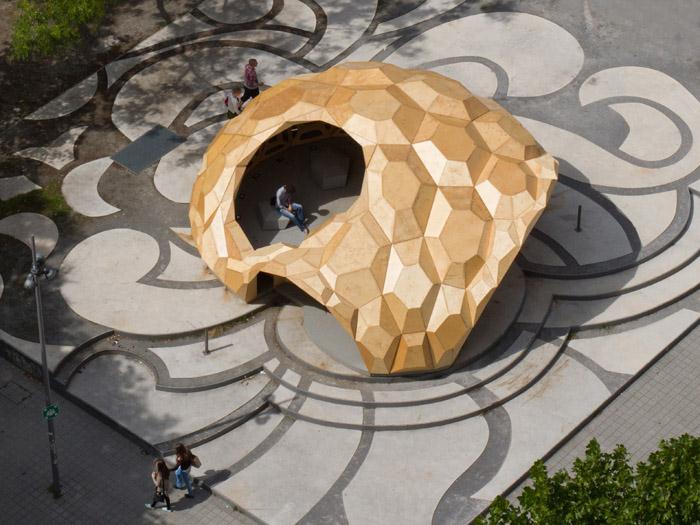

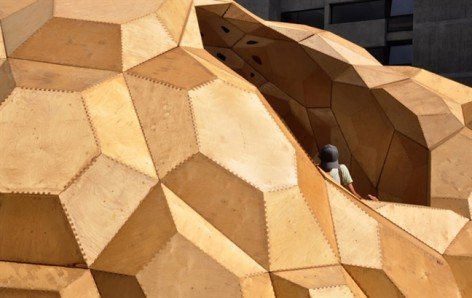
In summer 2011 the Institute for Computational Design (ICD) and the Institute of Building Structures and Structural Design (ITKE), together with students at the University of Stuttgart have realized a temporary, bionic research pavilion made of wood at the intersection of teaching and research. 同题参见
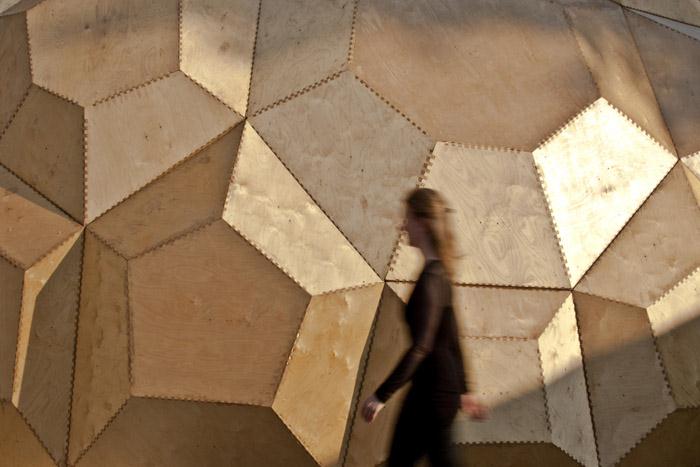
The project explores the architectural transfer of biological principles of the sea urchin’s plate skeleton morphology by means of novel computer-based design and simulation methods, along with computer-controlled manufacturing methods for its building implementation. A particular innovation consists in the possibility of effectively extending the recognized bionic principles and related performance to a range of different geometries through computational processes, which is demonstrated by the fact that the complex morphology of the pavilion could be built exclusively with extremely thin sheets of plywood (6.5 mm). 相关文章
BIOLOGICAL SYSTEM
The project aims at integrating the performative capacity of biological structures into architectural design and at testing the resulting spatial and structural material-systems in full scale. The focus was set on the development of a modular system which allows a high degree of adaptability and performance due to the geometric differentiation of its plate components and robotically fabricated finger joints.
During the analysis of different biological structures, the plate skeleton morphology of the sand dollar, a sub-species of the sea urchin (Echinoidea), became of particular interest and subsequently provided the basic principles of the bionic structure that was realized. The skeletal shell of the sand dollar is a modular system of polygonal plates, which are linked together at the edges by finger-like calcite protrusions. High load bearing capacity is achieved by the particular geometric arrangement of the plates and their joining system. Therefore, the sand dollar serves as a most fitting model for shells made of prefabricated elements. Similarly, the traditional finger-joints typically used in carpentry as connection elements, can be seen as the technical equivalent of the sand dollar’s calcite protrusions.

MORPHOLOGY TRANSFER
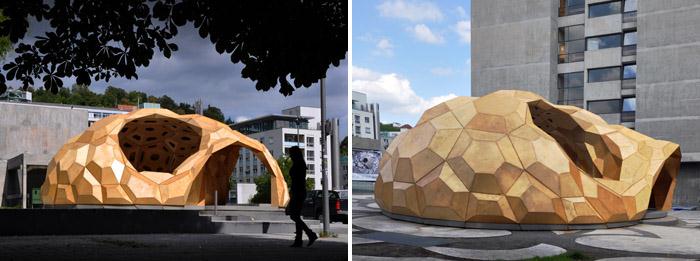
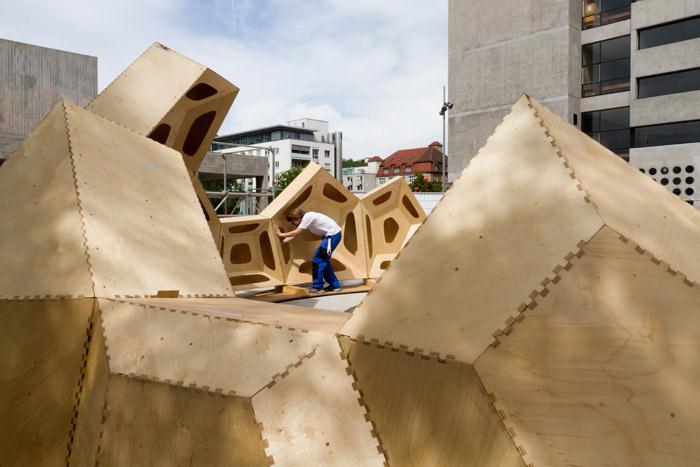
Following the analysis of the sand dollar, the morphology of its plate structure was integrated in the design of a pavilion. Three plate edges always meet together at just one point, a principle which enables the transmission of normal and shear forces but no bending moments between the joints, thus resulting in a bending bearing but yet deformable structure. Unlike traditional lightweight construction, which can only be applied to load optimized shapes, this new design principle can be applied to a wide range of custom geometry. The high lightweight potential of this approach is evident as the pavilion that could be built out of 6.5 mm thin sheets of plywood only, despite its considerable size. Therefore it even needed anchoring to the ground to resist wind suction loads. Besides these constructional and organizational principles, other fundamental properties of biological structures are applied in the computational design process of the project:
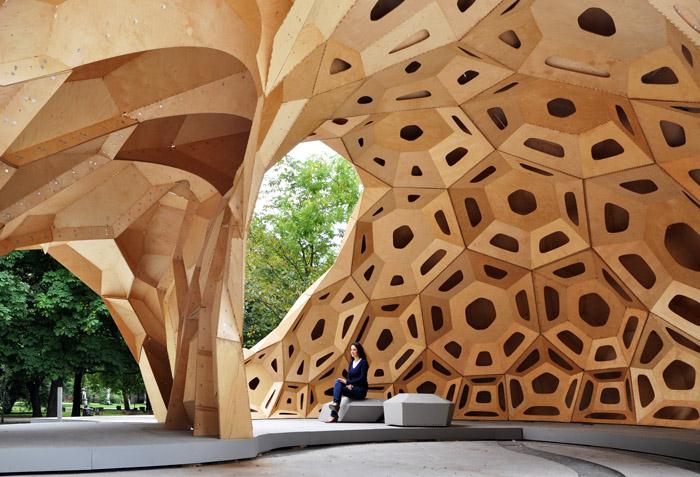
– Heterogeneity: The cell sizes are not constant, but adapt to local curvature and discontinuities. In the areas of small curvature the central cells are more than two meters tall, while at the edge they only reach half a meter.
– Anisotropy: The pavilion is a directional structure. The cells stretch and orient themselves according to mechanical stresses.
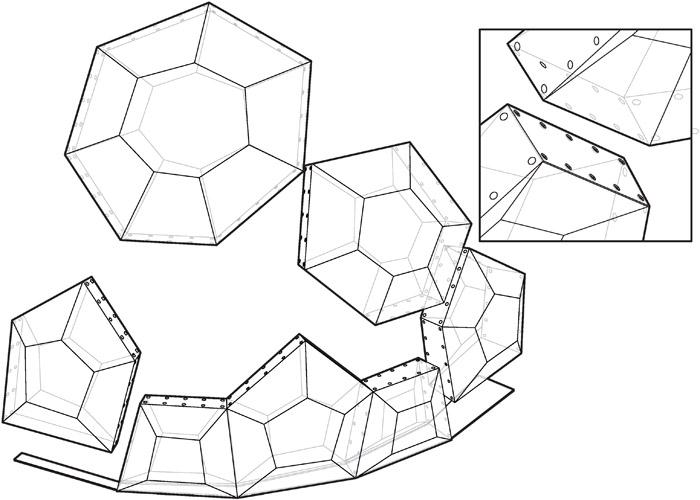
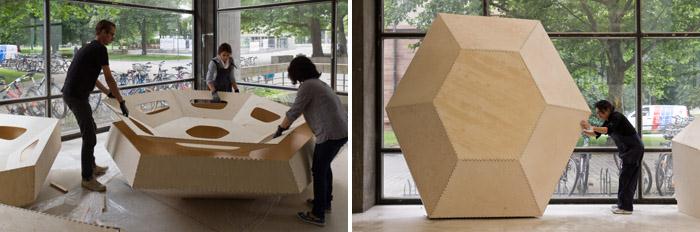
– Hierarchy: The pavilion is organized as a two-level hierarchical structure. On the first level, the finger joints of the plywood sheets are glued together to form a cell. On the second hierarchical level, a simple screw connection joins the cells together, allowing the assembling and disassembling of the pavilion. Within each hierarchical level only three plates – respectively three edges – meet exclusively at one point, therefore assuring bendable edges for both levels.
COMPUTATIONAL DESIGN AND ROBOTIC PRODUCTION
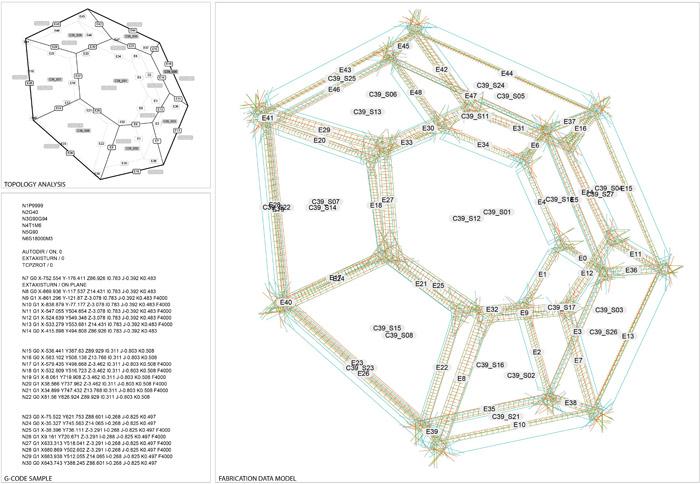
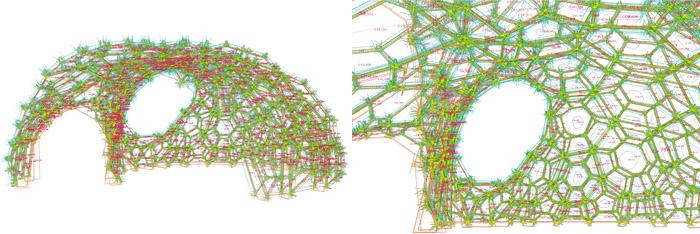
A requirement for the design, development and realization of the complex morphology of the pavilion is a closed, digital information loop between the project’s model, finite element simulations and computer numeric machine control. Form finding and structural design are closely interlinked. An optimized data exchange scheme made it possible to repeatedly read the complex geometry into a finite element program to analyze and modify the critical points of the model. In parallel, the glued and bolted joints were tested experimentally and the results included in the structural calculations.
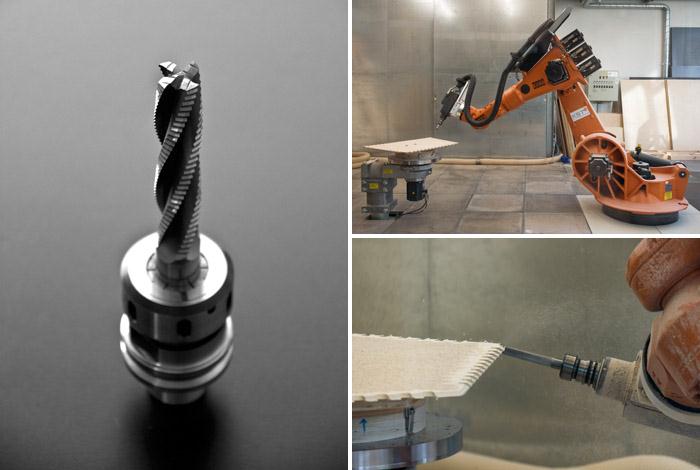
The plates and finger joints of each cell were produced with the university’s robotic fabrication system. Employing custom programmed routines the computational model provided the basis for the automatic generation of the machine code (NC-Code) for the control of an industrial seven-axis robot. This enabled the economical production of more than 850 geometrically different components, as well as more than 100,000 finger joints freely arranged in space. Following the robotic production, the plywood panels were joined together to form the cells. The assembly of the prefabricated modules was carried out at the city campus of the University of Stuttgart. All design, research, fabrication and construction work were carried out jointly by students and faculty researchers.
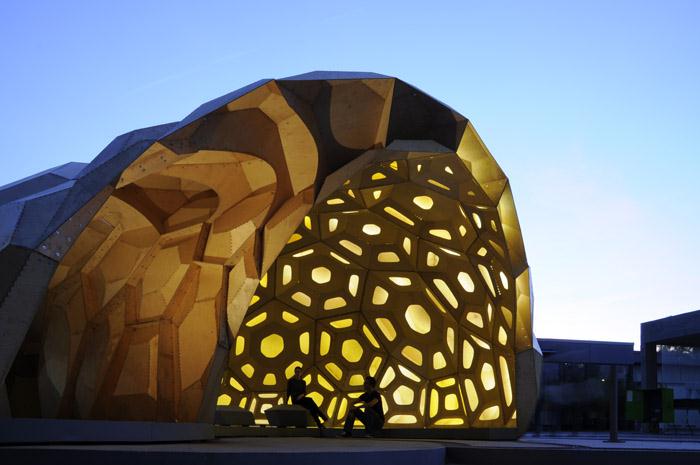
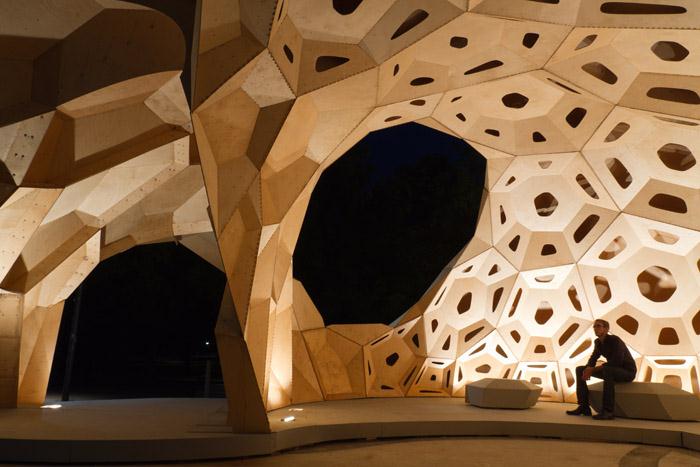
The research pavilion offered the opportunity to investigate methods of modular bionic construction using freeform surfaces representing different geometric characteristics while developing two distinct spatial entities: one large interior space with a porous inner layer and a big opening, facing the public square between the University’s buildings, and a smaller interstitial space enveloped between the two layers that exhibits the constructive logic of the double layer shell.
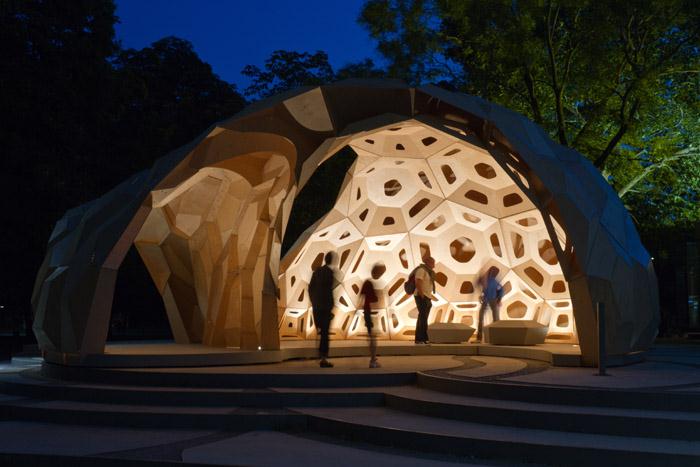
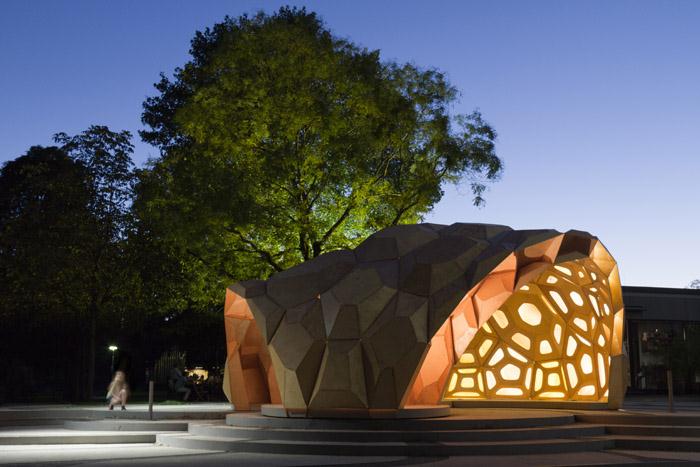
这是2011年夏季ICD,ITKE以及斯图加特大学英亚体育最新资讯最新版下载共同完成的一个研究教学临时木材展馆。通过计算机设计探讨海胆的骨架,并让其转化为实际的建造,这是一个创新。拓展了仿生学与英亚体育最新资讯最新版下载的结合度。展馆的复杂形态由不同几何形状的极薄(6.5毫米)胶合板组成。
生态系统
在英亚体育最新资讯最新版下载设计中融入对生物结构及其空间以及结构材料的全面研究测试。用模块化的系统达到高度适应性和性能。联接的方式是重要节点。分析海胆,并研究出仿生结构的基本框架。多变和和方解石般的表面突起有利于承载力。传统的木工链接节点非常优美。
形态转换
将这些板组合设计成亭子。其板块边缘让力汇聚到一个区域,使得弯矩传输力为零,就不会变形。传统的轻质结构只能预置固定的形态转载,而这个结构允许广泛范围几何体形。胶合板只有6.5毫米厚,却能组建相当规模的亭子,仅仅只需要固定在地面上就能抵抗风荷载。真是非常有潜力。此外还有一些生物结构的基本应用法则:异质性—–单元大小不一,适应各种曲率和连续性。异向性—-丁香结构。单元各自伸展定位自己的机械应力。层次—-双层,第一层胶合板相互粘接形成基本单元。第二层用简单的木卡槽让单元连接在一起。便于组装拆卸。
计算机设计和机器人
生产计算机设计后有及其生产单元板和链接处的节点。人们使用代码控制机器,经济的生产了850多个不同的几何组件,以及上面超过10万的链接节点。亭子组装在斯图加特大英亚体育最新资讯最新版下载园。从设计,研发,制造和施工——-英亚体育最新资讯最新版下载,教员,研究人员全程参与。这个项目研究了模块化仿生英亚体育最新资讯最新版下载的方法,用任意多边形形成两种截然不同的空间实体。一个有孔的亭子和内部多孔的空间。这个两层高小亭子带着双层表皮安立在大英亚体育最新资讯最新版下载园之中。








PROJECT TEAM:
Institute for Computational Design – Prof. AA Dipl.(Hons) Achim Menges Achim Menges
Institute of Building Structures and Structural Design – Prof. Dr.-Ing. Jan Knippers
Competence Network Biomimetics Baden-Württemberg
CONCEPT & PROJECT DEVELOPMENT:
Oliver David Krieg, Boyan Mihaylov
PLANNING & REALISATION:
Peter Brachat, Benjamin Busch, Solmaz Fahimian, Christin Gegenheimer, Nicola Haberbosch,
Elias Kästle, Oliver David Krieg, Yong Sung Kwon, Boyan Mihaylov, Hongmei Zhai
SCIENTIFIC DEVELOPMENT:
Markus Gabler (project management), Riccardo La Magna (structural design), Steffen Reichert
(detailing), Tobias Schwinn (project management), Frédéric Waimer (structural design)
PROJECT SPONSORS:
Main sponsors: KUKA Roboter GmbH, Ochs GmbH
Sponsors: KST2 Systemtechnik GmbH, Landesbetrieb Forst Baden-Württemberg (ForstBW),
Stiftungen LBBW, Leitz GmbH & Co. KG, MüllerBlaustein Holzbau GmbH, Hermann Rothfuss
Bauunternehmung GmbH & Co., Ullrich & Schön GmbH, Holzhandlung Wider GmbH & Co. KG
PROJECT DATA:
Address Keplerstr. 11-17, 70174 Stuttgart
Date of completion August 2011
Surface 72m²
Volume 200m³
Material 275 m² Birch plywood 6,5mm Sheet thickness
MORE: Prof. Achim Menges,更多请至:University of Stuttgart on gooood



发表评论
你需要先 才能发表评论
社交登录
3 评论
设备齐全,我们太落后
不仅是技术的差距关键在于心态 急功近利的心态
想知道是怎么分割成多边形的